Throughout its history, Brighton College has championed the importance of open discussion, lively disagreement and having the confidence to speak up. From packed debating chambers to spirited mock elections, generations of pupils have tested ideas, challenged one another and discovered that democracy depends not just on institutions, but on participation. Free speech at Brighton has never meant simply having a voice; it has meant learning to use it thoughtfully, persuasively and with respect for others.
Democracy Week 2026 has provided an opportunity to revisit that rich tradition, so we took a look through the College archives to explore our long history of lively debate and keenly contested mock elections, finding notable examples from 1966, 2010 and 2024.
1966 – Age is no barrier to Politics
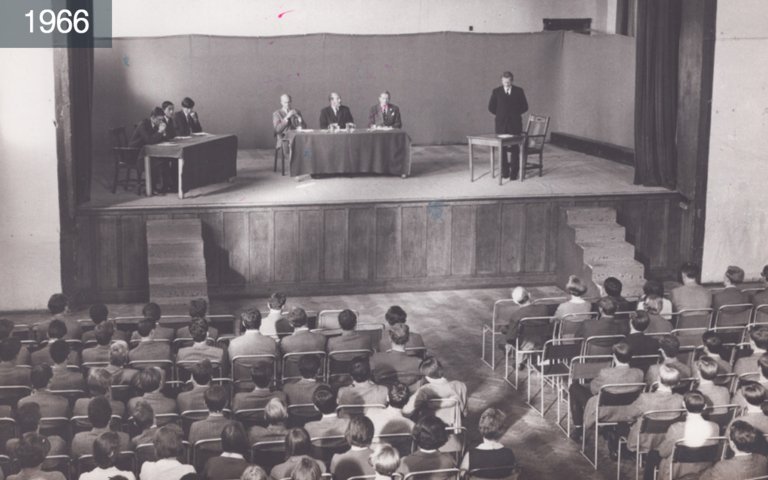
In 1966, the College staged two full mock general elections involving both junior and senior pupils. Campaigns were energetic, opinions strongly held, and the experience closely reflected the national political climate at the time.
The Senior School Debating Society focused on two major motions. The first, “This House considers the Labour Party have been in power too long,” was proposed by M. C. Mann (Du. 1956-66) and opposed by T. A. Edwards (Br. 1963-67) and J. J. Walenn (Br. 1963-68). Mann opened with a carefully prepared, statistics-rich speech, while Edwards responded with an equally detailed counterargument. Contributions from the floor added further variety: a Communist perspective, a warning against “lies, damned lies, and statistics,” and a Liberal viewpoint all featured. The motion was carried, but only by a narrow margin.
A second debate, “This House condemns the Labour Government for turning Great Britain into Little England,” proved even closer, passing by a single vote. Despite some concerns about the general standard of debate in the Senior School, an editorial in The Brightonian noted the clear promise shown by the younger debaters.
Meanwhile, the Junior School ran its own General Election following two weeks of vigorous campaigning by candidates representing the Conservative, Labour and Liberal parties. Posters, manifestos and speeches ensured high visibility, while hustings and question sessions tested the candidates’ ideas. On polling day, pupils gathered in the College Hall before voting, and the subsequent count created mounting tension. The final result gave victory to the Conservative candidate, but all agreed the campaigns had been conducted with intelligence and determination.
2010 – Every vote counts!
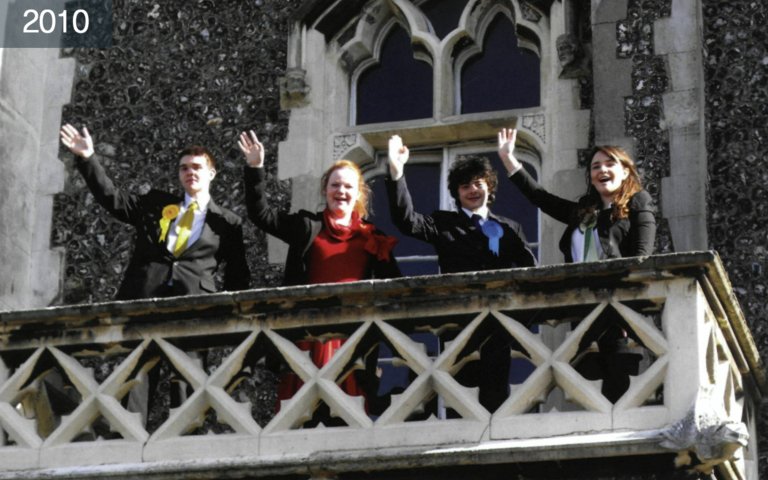
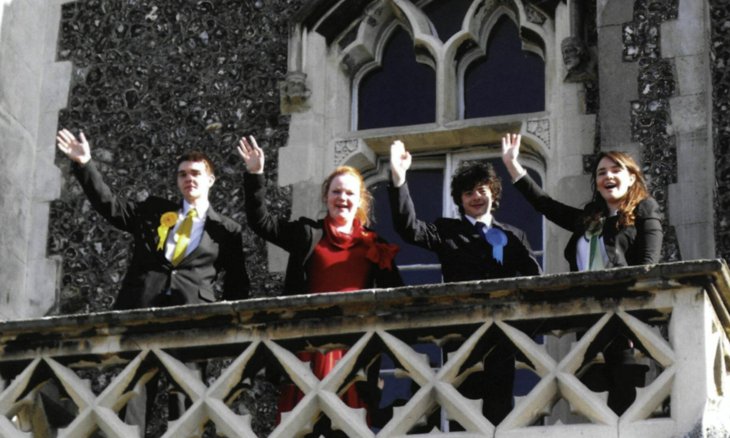
The 2010 mock election captured the excitement of the national contest and produced an exceptionally close result. The campaign began with hustings in the Chapel, where candidates delivered passionate speeches comparable in spirit to those seen in the televised leaders’ debates. Imaginative posters appeared across the school, creating a lively and engaged atmosphere.
When the votes were counted, Fergus Blair (Ha. 2007-11) of the Liberal Democrats emerged as the winner by a single vote, securing 189 votes against Eddie Henley (Ha. 2005-10) of the Conservatives with 188. The Green and Labour candidates followed behind.
There was further drama when the initial count appeared to show a Conservative victory, only for a recount to reverse the outcome. Several spoilt ballot papers added to the tension, underlining how small details can influence results. Voter turnout was recorded at 64% -incredibly close to the national figure at the time. The lesson was clear: every vote matters!
2024 – Democracy comes in many forms
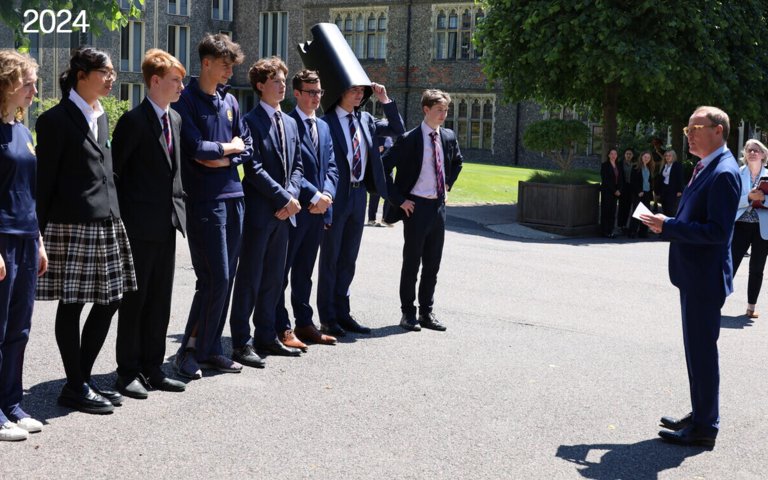
The most recent mock election, held alongside the 2024 General Election, aimed to familiarise pupils with the democratic process while adding a sense of end-of-term excitement. It sparked discussion across the school and gave many pupils their first experience of voting.
Candidates represented a wide range of parties, from Conservatives, Labour and Liberal Democrats to Greens, Reform UK, Communists and others. Alongside them stood the ever-present independent figure of British political satire, represented in this case by the independent candidate, Count Binface.
Campaign posters quickly appeared across the College, many drawing directly on real party manifestos. The campaign culminated in a lively hustings event in the Chapel, where each candidate delivered a short speech. Polling later that week was organised and run by the pupils themselves, ensuring the process felt authentic and participatory.
In the final result, Leon Croxford (Sc. 2019-24), standing for Count Binface, was elected Prime Minister for Brighton College, with the Green and Liberal Democrat candidates finishing close behind. While light-hearted, the outcome served as a reminder that democratic engagement can take many forms, and that humour has long coexisted with serious debate in British political life.
Theses examples span across seven decades, yet each generation of Brighton College pupils has clearly brought its own character to the democratic process. The underlying principles remain unchanged however: participation matters, debate is essential, and every voice has the potential to shape the outcome.