Over the last few months, the College Archivist has been working on an ambitious project: compiling a complete list of every Head of School at Brighton College, from the creation of the role in the 19th century, to the present day.
Using College rolls, Brightonian magazines, prefect photographs and other archival material, the project has pieced together a near-unbroken history of student leadership stretching back to 1874. Surprisingly, the only significant gaps appeared not in the Victorian era, but in several years during the 1970s and 1980s, when neither College rolls, nor magazines recorded the position. Thanks to the generosity and memories of Old Brightonians and former staff, those missing names have now been recovered.
The project has also revealed how the title itself evolved over time. The role was known as Captain of the College until 1875, Captain of the School between 1875 and 1885, Senior Prefect from 1885 to 1912, Captain of School once again from 1912 to 1934, and finally Head of School from 1934 onwards.
Alongside assembling the list itself, the research uncovered a fascinating history of prefects and student leadership at Brighton College:
One of the earliest references comes from Sir Thomas Holland, a pupil between 1847 and 1853, who later recalled at an 1885 Old Boys’ Dinner that “minor disturbances” during his schooldays led to the creation of “an order of praepositors.” This suggests that prefects existed almost from the College’s earliest years.
Further evidence appears in a remarkable series of cartoons drawn in 1848 by 17-year-old pupil Alfred Thompson. The illustrations depict the procession from Portland Place, the College’s original site, to the laying of the foundation stone at the present campus, then known as Bakers Bottom. Among the figures are boys labelled “ye prepositores”, confirming that the role had already been established by the summer of 1848.
For much of the 19th century, the Captain of the School was elected by universal suffrage among the boys. The position carried considerable responsibility, including chairing the pupil Finance Committee alongside the captains of Cricket, Football and Fives, as well as leaders of the Debating Society, Reading Club and the school magazine.
A major turning point came in 1875 under Principal Bigg. Senior boys had previously been appointed directly as praepositors, but Bigg introduced a junior rank of “probationers” - apprentice prefects if you will - who assisted with discipline while learning the responsibilities of office. Three years later, Bigg made another significant reform - the Principal, rather than the pupils - would choose the Captain of the School from among the praepositors. The change marked a wider shift in authority from pupil democracy towards staff oversight and the emergence of a more formal prefect system.
By the 1880s, the structure had evolved into something much closer to the modern system, with the Captain of the School becoming the Senior Prefect and the praepositors simply known as prefects.
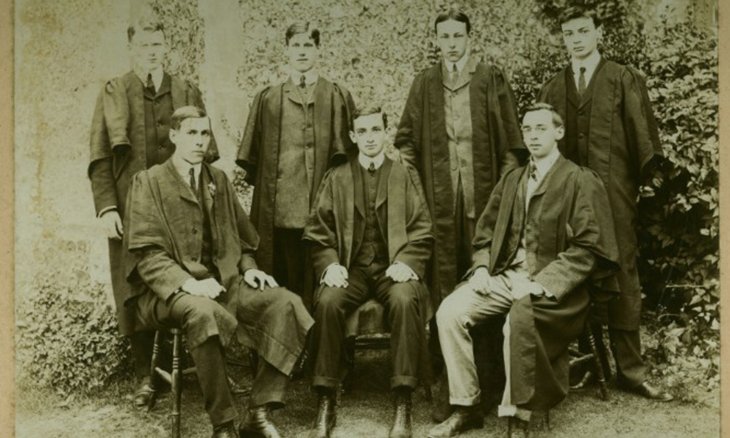
Accompanying this article, the earliest surviving prefect photograph dates from 1906 and the first year of Canon William Dawson’s 27-year tenure as Head Master. At its centre sits Senior Prefect Sydney Castle Roberts, surrounded by fellow prefects. During Dawson’s era, prefects adopted distinctive blazers, ties and boaters - and, briefly in the 1920s, silver-topped black canes.
After the Second World War, many prefect powers were gradually reduced as pupil life modernised. Another landmark moment came in 1993–94, when Eleanor Davey became Brighton College’s first female Head of School, reflecting broader changes within the College community itself.
At Speech Day on 20 June 2026, the next name will be added to this distinguished list - and the story of Brighton College Heads of School will continue into its next chapter.
The plan now is to recognise the generations of pupils who have held the school’s highest student office using a permanent honours board at the College. We will keep you updated.
______
Whether it is a photo, uniform, diary, or program from a school play, every piece of history speaks to our shared journey. The Brighton College Archive contains hundreds of fascinating primary sources and we actively encourage interested OBs to get in touch and arrange a tour.
If you have any historic artefacts, documents, or memories from your College days that you would be willing to share with us, please contact our College Archivist, Mr James Harrison.