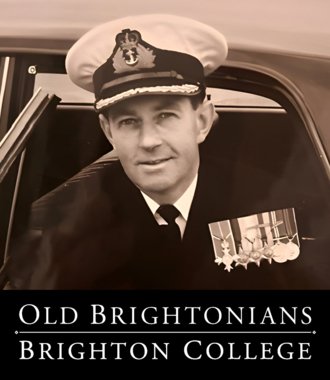
Brighton College remembers Captain Stuart Farquharson-Roberts RN, OBE (Mil.) (Sc. 1935-40), who died on 26 June 2026, aged 104.
Born near Farnham, Surrey, on 3 June 1922, Stuart was an only child. He attended Brighton College before entering the Britannia Royal Naval College, Dartmouth, in June 1940. Just two days into his training, on his 18th birthday, he learnt that his father, serving with the British Expeditionary Force, had escaped from Dunkirk aboard a destroyer.
Stuart volunteered to continue his naval training at sea. One of only three cadets selected to join the Australian heavy cruiser HMAS Australia, he was soon in action.
In September 1940, Australia was part of Force M during Operation Menace, the Allied attempt to bring the Vichy French-controlled port of Dakar over to the Free French cause. When the French destroyer L’Audacieux approached, the British ship ordered it to surrender. As the officers on the bridge lacked sufficient French, the young Farquharson-Roberts was summoned. He consulted a dictionary to find the French word for “sunk” and delivered the ultimatum by signal lamp. The response was “Jamais” - “Never”. The order was given to open fire, and within minutes L’Audacieux was ablaze.
His wartime service subsequently took him across the Atlantic and into some of the most hazardous theatres of the conflict. He served aboard the cruiser Cumberland in the waters between Iceland and Greenland, escorted east coast convoys in destroyers, and took part in Operation Torch, the Allied landings in French North Africa, commanding Landing Craft Assault vessels.
He later joined the escort carrier HMS Archer, before becoming navigation officer aboard HMS Westcott. In 1943-44 he made several Arctic convoy voyages between Britain and the Soviet Union, enduring freezing conditions, near-continuous darkness and the threat of German U-boats. He witnessed, from a distance, the Battle of the North Cape, in which the German battleship Scharnhorst was sunk.
In the final months of the war, Stuart became first lieutenant of HMS Conn. At just 22, he was briefly entrusted with command of the destroyer - an exceptional responsibility for an officer so young. The 21st Escort Group, of which Conn was part, sank three U-boats in March 1945. Stuart also skilfully manoeuvred the ship under German shore fire and, in an extraordinary episode, assisted the ship's surgeon during an emergency appendicectomy while Conn was engaged in depth-charge attacks.
He led Conn's company in the liberation parade at Bergen in May 1945, bringing an extraordinary wartime chapter to a close.
Stuart remained in the Royal Navy after the war, specialising in torpedo and anti-submarine warfare. His subsequent appointments included command of motor torpedo boats and naval training establishments. In 1956 he was seconded to the Pakistan Navy to train officers, for which he was appointed OBE (Military) in 1958. He later served as naval attaché in Cairo and Khartoum, commanded HMS Vernon, the Navy's torpedo and anti-submarine training establishment, and became Director of Foreign and Commonwealth Training.
He retired from the Royal Navy in 1977, but his commitment to education continued. He studied mathematics and science with the Open University and taught at the Pilgrims' School in Winchester until 1987. He subsequently tutored pupils from his home near Petersfield for many years.
Away from professional life, Stuart was an enthusiastic sailor, cricketer (and national cricket coach), musician, gardener, bridge player and traveller. He played both the cello and piano and had a particular love of Gilbert and Sullivan and classical music. Above all, it seems, he remained happiest on the water.
Captain Stuart Farquharson-Roberts leaves behind an extraordinary legacy of service, courage, and a commitment to education - qualities that will be remembered with pride by the Old Brightonian community.