
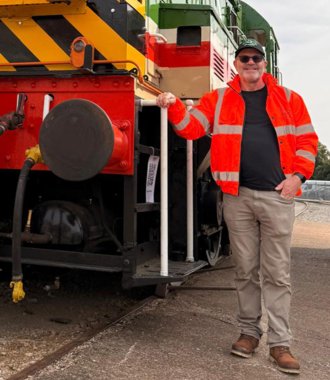
Dr Jeff Allan (Ha. 1968-73) is an engineer, innovator and recently appointed Honorary Professor in Railway Power and Traction Systems at the University of Birmingham. He has spent almost five decades at the forefront of railway engineering and sustainable transport. From researching regenerative braking long before electric vehicles became commonplace, to helping design the UK's first hydrogen-powered trains and setting Guinness World Records for electric vehicle journeys, his career has combined technical excellence with a determination to use engineering as a force for positive change.
You have spent almost 50 years at the forefront of railway engineering, from your early work on electrical systems to helping develop the UK's first hydrogen-powered trains. Looking back, what are the most significant changes you have witnessed in the industry, and which developments do you think will define its future?
I was reminded during the railways' 200th anniversary last year that I have worked in the industry for almost a quarter of that time. The biggest changes I have witnessed are the expansion of rail networks, the development of high-speed rail, widespread electrification, and major efficiency improvements through digital and power electronic technologies. Unfortunately, the UK has not always been at the forefront of these developments, and much of my early innovation work took place overseas.
One exception is railway safety, where the UK has often led the way. I was fortunate to contribute to that work during my time with the Rail Safety and Standards Board. I would also like to think that customer and staff needs are considered more carefully today, although there is still room for improvement.
Throughout your career you've worked across rolling stock, electrification, signalling, systems engineering and research. Is there a particular engineering challenge or project that stands out as the moment you felt you made the greatest impact?
My greatest impact was resolving the Central Line power failure, which caused seven days of disruption and chaos for commuters across London. I have recently given a Mellitt Memorial Lecture intended for non-experts on this subject.
You designed the electrical system for HydroFLEX, the UK's first hydrogen train, and more recently worked on Hydroshunter, a hydrogen-powered locomotive. What were the biggest obstacles in turning these ideas into operational technology, and what did you learn from the experience?
Most of the technical challenges were relatively straightforward to solve, although there were many of them. Today, the greatest obstacle is convincing a traditionally conservative railway industry that hydrogen, battery technology and partial electrification are realistic options for decarbonising many non-electrified routes and eliminating diesel traction.
Decades before electric vehicles became mainstream, your PhD research focused on regenerative braking, a technology now central to modern EVs. Did you have a sense then that this would become such an important part of the future of transport?
When I completed my PhD between 1977 and 1980, regenerative braking was already recognised as the final piece of the puzzle in making electric trains the most efficient form of land transport. My research focused on a very specific aspect of that technology.
Electric trains benefit from low friction between steel wheels and rails, low aerodynamic resistance, and efficient electrified power systems. By the time electric cars became viable, regenerative braking was already well established in railways. During my PhD, however, widespread electric vehicles felt like a distant prospect until advances in battery technology, particularly the move from lead-acid to lithium-ion batteries, made them practical.
Alongside your professional work, you've set Guinness World Records in electric vehicles with your son Ben, including journeys from Land's End to John O'Groats and across Europe. What inspired those challenges, and what did they reveal about public perceptions of electric vehicles at the time?
I had been driving an electric car since 2010 and recognised the importance of the technology when very few others did. In 2015 and 2017, Ben and I wanted to demonstrate that electric vehicles were not only usable but practical for long-distance journeys.
For our second Guinness World Record, we travelled 8,000 miles in a single journey. Even now, many people still believe electric vehicles are unsuitable for long-distance travel. Since then, I have driven across most of mainland Europe and Iceland. These days, I do not fly.
A recurring theme in your career has been using technology to reduce environmental impact, and your company recently became a certified B Corp. Have you always seen engineering as a way to improve society, and where does that sense of purpose come from?
I have always seen engineering as a means of improving people's lives. I enjoy the technical challenge, so perhaps my motivation is a little selfish. In recent years I joined Humanists UK because its values best reflect my belief in the positive potential of humanity. Throughout my career, I have deliberately steered away from areas that I felt did not contribute positively to society.
You've worked with universities, industry leaders, government bodies and international projects, and in 2023 were appointed Honorary Professor in Railway Power and Traction Systems at the University of Birmingham. What advice would you give to young engineers who want to make a meaningful difference in the world?
Continually learn. I have never stopped. Challenge everything until you are satisfied you understand how it works. And study hard. A good engineer is proficient in physics and mathematics.
Brighton College seems to have played an important role in shaping your interests. You have spoken previously about the influence of your Maths and Physics teachers and even built a car while you were here. What memories from your time at the College have stayed with you, and what does being part of the Brighton College alumni community mean to you today?
I benefited enormously from Mathematics teachers Rodney Fox and Oliver Smyth, and Physics teachers Colonel David Gibson and Peter Andrews. I still remember lessons in calculus and applied mathematics, and a memorable exercise in which Peter Andrews drove a group of us in his Volkswagen while we recorded speed, distance and time before analysing the results back in the classroom.
I also felt privileged to be taught by Colonel Gibson, a Second World War signals officer and recognised expert in radio technology. He built my confidence in electronics and helped shape my future career. I greatly enjoyed English Literature too, although at the time it was not possible to study both arts and sciences at A-level.
Beyond the academic lessons, Brighton College taught important social skills. I have been particularly impressed by recent Head Teachers' emphasis on developing character and human qualities alongside academic achievement.