
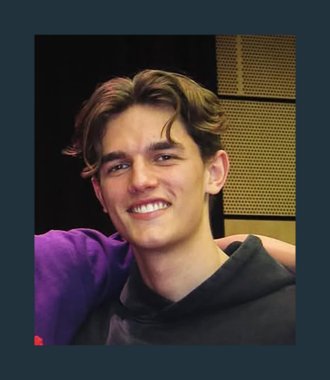
Joshua Jooste (Ry. 2022-24) is the co-founder of Authoreate - an academic publishing platform that addresses the basic question, “What’s the point of cutting-edge research if no one outside academia can access, or understand it?” Their mission statement reads, The greatest ideas in the world are locked inside papers almost nobody reads. We are changing that.
AI is often discussed in abstract, or even alarming terms. From your perspective as someone actively building in the space, what do you think most people misunderstand about where this technology is heading?
I think most people misunderstand who AI is going to affect most. There’s a lot of concern about Gen Z, and in the short term I understand why - over the next couple of years, as junior roles get cut, younger people will feel some pain. But I think people my age are in a relatively strong position to adapt. We generally have lower fixed costs, fewer responsibilities, and more freedom to be agile, learn new skills, and reposition ourselves as the job market changes.
The people I worry about more are white-collar workers in their thirties and forties with mortgages, children, and established careers. They don’t have the same flexibility to start over or retrain quickly. Very few people seem to be thinking about this group specifically, especially from a policy perspective.
Your work to date seems to sit at the intersection of AI, storytelling, academia and entrepreneurship. What is the common thread that connects all those interests for you personally?
The common thread is that they all have the power to shape society in profound ways. AI has the potential to revolutionise every industry - not just through LLMs, but also through advances in reinforcement learning, robotics and beyond. Storytelling matters because it’s the most powerful way humans transfer information and influence behaviour. Tesla is a good example: at its peak, it was worth more than the next ten automakers combined while producing around only 1% of global vehicles. The gap between fundamentals and valuation was, in large part, the story Elon Musk was able to tell.
I also see academia as a form of storytelling - structured communication applied to trial and error in the pursuit of truth. And entrepreneurship is how those ideas become real-world change in a capitalist system.
You’ve already worked across several ambitious ventures, including Passionfruit, Barebone and now Authoreate. What tends to drive your decisions when choosing what kinds of projects to commit your time and energy to?
It’s cliché, but it’s always the people. When I joined Barebone, I knew within a 30-minute conversation with Brian (Tam) that there was a huge amount I could learn from him - especially in how he thinks strategically and solves problems. He taught me a lot about agency and wasn’t afraid to give direct feedback, which I appreciated.
At Passionfruit, it was similar. The sales and marketing teams were exceptional, and I learned a lot just by being around them. Their growth - from zero to $1m ARR in 90 days with their product PIP - reflects both the strength of the product and the quality of their distribution.
Was Brighton College influential in shaping the direction you’ve taken at all?
Yes. All three startups I’ve worked for were co-founded by Old Brightonians: Barebone with Brian Tam (He. 2013-18), Passionfruit with Iss Abdul-Moomin (Ab. 2009-11), and now Authoreate, which I’ve co-founded with my business partner Matthew Thoomkuzhy.
More broadly, Brighton College gave me confidence. When you’re surrounded by people doing impressive things, it normalises the idea that you can do something similar. It raises your baseline expectations. I wouldn’t say I’m there yet, but it’s given me a persistent belief that I’ll build something interesting eventually, as long as I keep learning from the people I’ve met through that network.
For readers who may not be familiar with it, what exactly is Authoreate trying to solve and what made you feel this was a problem important enough to dedicate yourself to?
There are three main problems in academia as I see it:
First, papers aren’t written or published in a way that’s accessible to most people. Second, the publishing system is slow, bureaucratic, and structurally extractive - academics often give away their work and peer-review time for free, while publishers charge high fees. Third, academics are generally poorly compensated for work that society, industry, and policymakers ultimately depend on.
I think that’s a problem for society, innovation, and even politics. It raises a basic question: “What’s the point of cutting-edge research if no one outside academia can access or understand it?” We’re starting with accessibility because it’s the lowest-hanging fruit. That means a clean, simple interface, AI-powered summaries that turn papers into readable articles, and better discovery tools so people don’t have to manually search - the system should surface what matters.
Longer term, the ambition is bigger. I want Authoreate to be a place where academics are properly paid for the value they create - whether that’s writing for wider audiences, appearing on podcasts, or eventually even negotiating how their work is used as training data for LLMs. Right now, I’m focused on building a network of academics who want to write or come on a podcast, and I’m actively looking for more people to get involved.
And finally, if you could give one piece of advice to a current Brighton College pupil who is curious about AI, startups, or creative technology, but has no idea where to begin, what would it be?
I actually have three main pieces of advice:
First, if you want to be good at something, just be good at it! Most people are far more capable than they realise, but they underestimate themselves. With AI and YouTube today, you can learn almost anything if you put in enough time.
Second, don’t wait for permission. If you want to work somewhere, build something for them - a feature, a prototype, even a marketing video. Then ask for the job once you’ve already created value. Action opens more doors than applications.
Third, download X and Substack. These platforms can introduce you to ideas you wouldn’t otherwise encounter - but you still need intent. Train your feed’s algorithm towards science, finance, startups, and technology, otherwise you risk drowning in all the noise!
___
Visit Joshua’s site, Authoreate at https://www.authoreate.com/