
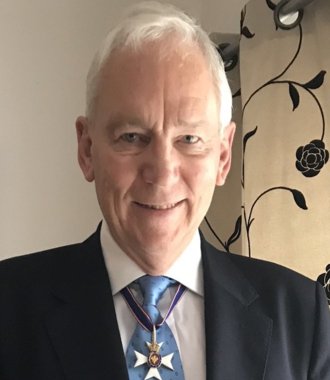
Architect Sir John Tiltman KCVO (Ha. 1950-60) reflects on an extraordinary career that has taken him from designing council housing, to leading the care and restoration of some of the nation's most significant historic buildings, including Buckingham Palace and Windsor Castle:
When you look back on your time at Brighton College, what are your strongest memories of school life beyond the classroom?
My strongest memories are of the five years in the Senior School. The first big change was the very formal school uniform: a three-piece suit for formal wear, a tweed jacket for school days, both with separate white collars that needed to be starched and replaced each day. The blazer and straw hat for summer wear were completed by a cravat instead of a tie. Photos of today’s sensibly dressed pupils leave me envious.
Otherwise, I remember the great variety of school sports, both team games and individual. I greatly enjoyed squash, fives and fencing, as well as the CCF, run by officers who had served in the Second World War and were greatly respected.
You have credited your Art Master, Gordon Taylor, with setting you on the path to architecture. What was it about him, or that conversation, that made such a lasting impression on you?
Gordon Taylor was an inspirational Art Master who encouraged a number of us in his A level class to consider architecture. I think seven of my A level Art Group followed that route, two of us going to the local Art College while others enrolled at universities further afield.
I am ashamed to say that Art was my only A level pass but, fortunately, in those days that was not a barrier to being accepted into Art College. I was also fortunate that my uncle ran the well-respected architectural practice Tiltman and Howard in East Street, Brighton, so his reputation may have helped my application.
Your career took you from designing council housing to looking after Buckingham Palace and Windsor Castle. Was there a particularly striking project or moment when you realised you had arrived somewhere extraordinary?
My first job was with the Greater London Council in their town development team. At the time, the GLC was constructing housing outside London to help relieve overcrowding, so my first project was the construction of several hundred council houses outside Wellingborough.
I left the GLC shortly before it was disbanded to become a government architect, designing three large housing estates for MOD officers serving in Whitehall.
I then worked on telephone exchanges, buildings within Royal Navy shore establishments and, finally, in my late forties, secured the post of Head of the Royal Palaces Group, leading a team of over one hundred.
In 1990 the government decided to privatise the Property Services Agency. The organisations it served - including the MOD, Law Courts, Prison Service, Royal Household, Historic Royal Palaces and Royal Parks - were each required to establish their own works organisations.
I applied, in open competition, to lead the new works organisation for the Royal Household estate and secured the post. In December 1990 I resigned from the Civil Service to join the Royal Household. Then on 2nd January 1991 I loaded my car with my belongings from my PSA office and drove to Buckingham Palace, parking on the forecourt. That was the moment I realised my life had changed. Having started my career designing council housing, I now found myself in a beautiful office at Buckingham Palace, responsible for maintaining Her Majesty The Queen’s palaces. Less than two years later, the fire at Windsor Castle changed everything.
The restoration of Windsor Castle after the 1992 fire was one of the most significant heritage projects of its time. What was your role?
The terrible fire at Windsor Castle presented a massive challenge which dominated my life for the following five years. Because of the project's prestige, we were able to attract the very best professionals, contractors and craftspeople from across the British construction industry.
My task was to work with the project managers to ensure everything on schedule and within budget, while achieving the highest possible quality. In the event, we completed a magnificent restoration in time for Her Majesty’s fiftieth wedding anniversary, several months ahead of schedule and around £4 million under budget.
You worked closely with the Royal Household for more than a decade. What aspects of that role surprised you most when you first joined, and what gave you the greatest satisfaction?
My job was not just to manage the property department but also to work closely with those responsible for the many departments and services supporting the Royal Family. I found great satisfaction in restoring staff accommodation as well as delivering larger projects.
These included refurbishing the main quadrangle of the Royal Mews at Buckingham Palace, including rehousing the Gold State Coach; working with the Queen’s Chaplain to refurbish the Chapel Royal at St James’s Palace and restore the chapel at Kensington Palace, which had sadly been used for storage since the death of Queen Victoria and working with the Royal Collection to create a new gallery at Buckingham Palace, enabling more of the collection to go on public display.
And finally, what advice would you offer today's Brighton College pupils who may not see themselves as the most academic students but are trying to find the right career path?
The main thing is to find a career that gives you job satisfaction. Then throw yourself into gaining the qualifications and experience you need. You only live once, so spend your working life doing something you genuinely enjoy. Ask yourself: "If I didn't need the money, would I still want to do this?" For me, the answer was yes!